Physical Address
304 North Cardinal St.
Dorchester Center, MA 02124
Physical Address
304 North Cardinal St.
Dorchester Center, MA 02124

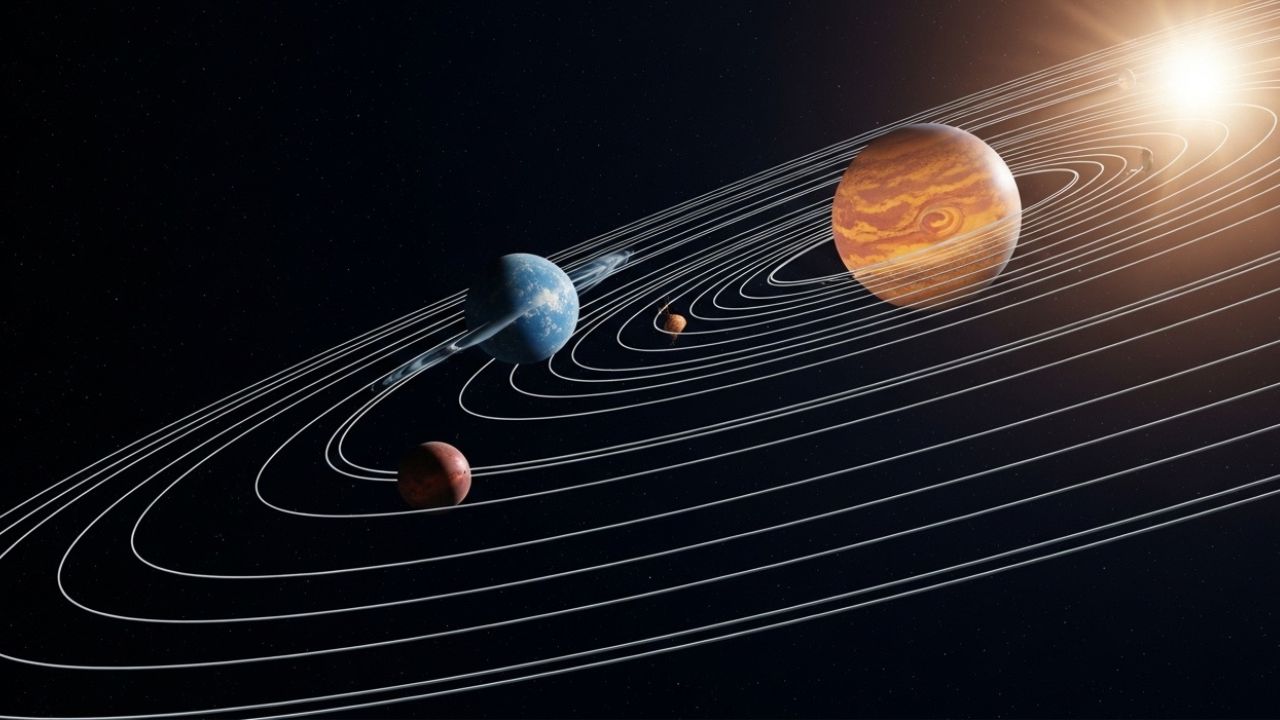
The Solar System is the vast cosmic neighborhood that includes the Sun, eight planets, moons, asteroids, comets, and countless other celestial objects bound together by gravity. Centered around the Sun, the Solar System has fascinated scientists and stargazers for centuries. Understanding the Solar System helps us learn not only about space but also about the origins of Earth and the potential for life beyond our planet.
In this comprehensive article, we explore the formation of the Solar System, its structure, the planets, dwarf planets, and other key components that make up this extraordinary system.
Scientists believe the Solar System formed approximately 4.6 billion years ago from a giant cloud of gas and dust known as a solar nebula. Through a process called gravitational collapse, the cloud condensed and began spinning, eventually forming the Sun at its center.
As the Sun formed, remaining particles collided and stuck together, creating planetesimals. Over time, these grew into planets, moons, and other bodies. The Solar System gradually evolved into the structured system we observe today.
At the center of the Solar System lies the Sun. The Sun accounts for more than 99% of the system’s total mass. Its powerful gravitational pull keeps all planets and objects in orbit.
The Sun produces energy through nuclear fusion, converting hydrogen into helium. This energy provides light and heat essential for life on Earth. Without the Sun, the Solar System would not exist in its current form.
The Solar System contains eight recognized planets, divided into two main groups: terrestrial planets and gas giants.
The inner planets are rocky and smaller in size:
Mercury – The closest planet to the Sun and the smallest in the Solar System.
Venus – Known for its thick atmosphere and extreme surface temperatures.
Earth – The only known planet that supports life.Mars – Often called the “Red Planet” due to its reddish appearance.
The outer planets are much larger and primarily composed of gases or ices:
Jupiter – The largest planet, famous for its Great Red Spot storm.
Saturn – Recognized for its spectacular ring system.
Uranus – Rotates on its side, making it unique among planets.
Neptune – Known for its deep blue color and strong winds.
These planets orbit the Sun in elliptical paths, each with distinct characteristics.
Beyond the eight main planets, the Solar System includes dwarf planets. One of the most famous is Pluto. Once considered the ninth planet, Pluto was reclassified as a dwarf planet in 2006 by the International Astronomical Union.
Other dwarf planets include Eris, Haumea, and Makemake. These bodies share similarities with planets but do not meet all the criteria required for full planetary status.
The Solar System contains millions of smaller objects.
Between Mars and Jupiter lies the asteroid belt, a region filled with rocky fragments. These remnants are leftovers from the early formation of the Sol-ar System.
Comets are icy objects that originate mainly from the Kuiper Belt and the distant Oort Cloud. When they approach the Sun, they develop glowing tails due to solar radiation.
These smaller bodies provide valuable information about the early So-lar System’s composition.
Many planets in the So-lar System have natural satellites, commonly called moons. Earth has one moon, while other planets have many.
For example, Jupiter has dozens of moons, including Ganymede—the largest moon in the So-lar System. Saturn’s moon Titan is known for its thick atmosphere and lakes of liquid methane.
Moons play an important role in stabilizing planetary systems and influencing tides and climates.
Beyond Neptune lies the Kuiper Belt, a region filled with icy bodies and dwarf planets. This area marks the outer edge of the main So-lar System.
Farther still is the theoretical Oort Cloud, a distant spherical shell of icy objects believed to surround the Solar Syst-em. It is thought to be the source of long-period comets.
These outer regions show that the Solar Sysem extends much farther than the visible planets.
Studying the Sol-ar System helps scientists understand planetary formation and the conditions necessary for life. Space missions have provided valuable insights:
Mars rovers analyze soil and search for signs of past life.
Probes explore Jupiter and Saturn’s moons.
Telescopes observe distant objects beyond Neptune.Exploration of the Solar Syst-em continues to expand our knowledge of the universe.
Jupiter’s mass is more than twice that of all other planets combined.
A day on Venus is longer than a year on Venus.
Neptune has the strongest winds recorded in the Solar Syst-em.
Saturn’s rings are made mostly of ice particles.
These fascinating details highlight the diversity and complexity of our cosmic neighborhood.
Advancements in technology are paving the way for deeper exploration of the Solar Sys tem. Space agencies plan future missions to Mars, Europa, and beyond.
Private companies are also entering the field of space travel, potentially opening new chapters in Solar Sys tem exploration.
As scientific tools improve, our understanding of the Solar Syste m will continue to grow.
The Solar Syste m is a dynamic and complex structure centered around the Sun. From rocky inner planets to massive gas giants and icy outer regions, the Solar Syste m showcases extraordinary diversity.
By studying the Solar Syste m, scientists uncover clues about Earth’s origins, planetary science, and the possibility of life elsewhere. As exploration continues, the Solar Syste m remains one of humanity’s greatest scientific frontiers.